July 27, 2012

Custom order Tenugui and Furoshiki

Hello and Welcome to www.nipponcraft.com,

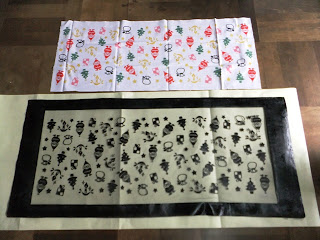
We have set up websites to accept custom tenugui from worldwide. We will print your design and logo on tenugui with the Japanese traditional dye method "Chu-sen".  "Chu-sen" makes the tenugui double-sided beautifully, so there is no front-side and back-side. I mean that the back-side of a mirror image of the front-side design.

Custom order tenugui can the anniversary gift for  "kendo" dojo.

Tenugui are 100% cotton and we produce your tenugui all in Japan. All handmade tenugui will give you a warm touch of craftsman and natural taste.

For customized order, please click the banner.


We also accept custom print furoshiki. Furoshiki is a square size cloth made of cotton.  Furoshiki can be a substitution of a shopping poly bag, gift wrapping and a scurf for fashion. 
We will make a silk screen to print your design and hand-print in Kyoto.

We have  business relationships with traditional artisans, so we can deliver genuine tenugui and furoshiki to worldwide.

Thank you for visiting our blog!

July 20, 2012

New Noren door curtain added (affordable vesions)

Hello and Welcome to www.nipponcraft.com,

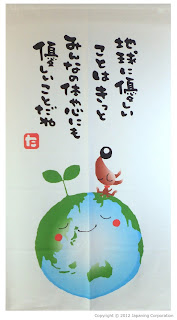
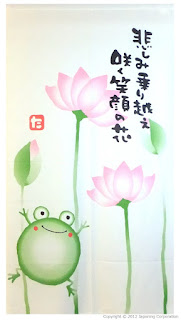
We have added affordable noren door curtains and tapestries in our lineup. These ones are produced in Kiryu-city (桐生市) in Gunma prefecture (群馬県).  The prices for world wide customers are the same as sold in Japanese domestic market.  I hope you will visit our site.


New Lineup

Smiling lucky cats : 2,100JPY
(Polyester 100%)

Red Fuji Ukiyo-e painting : 2,580JPY
(Cotton & Rayon)

Big wave Ukiyo-e painting : 2,580JPY
(Cotton & Rayon)
Sumo wrestler Ukiyo-e painting : 2,580JPY
Calligraphy tapestry : 1,980JPY
(Polyester 100%)
Calligraphy tapestry : 1,980JPY
(Polyester 100%)
Maple tapestry : 1,980JPY
(Polyester 100%)
Thank you for visiting our blog!

July 1, 2012

How hand-print furoshiki is made

Hello and Welcome to www.nipponcraft.com,

If you are interested in printing  your own design on furoshiki, I hope this article will help you understand the characteristics of hand-printing and also its limitation.
Most of furoshiki in Japan are produced in Kyoto. This is because many factories necessary for furoshiki production are concentrated in Kyoto. Furoshiki are produced through several processes such as cutting stencils, printing design, steaming and washing furoshiki, and each factory organizes the supply chain of furoshiki production.

We, nipponcraft, have partner factories in Kyoto and I shot these photos and interviewed artisans there.


First of all, you may wonder about the granularity of design but we can print a pattern as complex as the one you can see in the left photos. We can print many elaborate designs and patterns on furoshiki. But the thickness of lines and the circle diameter need to be more than 2mm.


This printed paper arrived from a customer for printing on furoshiki. I hope you can get an idea of the level of complexity we can manage to print.


This furoshiki is designed by a Finland designer and the furoshiki are sold at Japanese department stores. In these days, many furoshiki are designed by European designers, and many Japanese customers are accepting this movement.


To print your design on furoshiki, we prepare stencils at first. We prepare stencils of number of colors you want to print on furoshiki.
These days, many customers make their own designs on PCs, and the stencils are cut with the help of computers. So, your design can be exactly copied to furoshiki stencils.
These stencils can be kept in good condition for four to five years, and can be used for additional orders.


You can send your desired colors by either of Adobe, GIF or even printed papers with color swatches. In Japan, DIC color swatch is common but we can accept Pantone color swatch from international customers.


Then, an artisan will translate your desired color to a dyeing material mix. He has notebooks that keep huge number of mixes to make various colors. If he doesn't find the customer's color within his knowledge, he will create it. Many artisans say (boast?) that they can create infinit number of colors to reach customer's desire.


Next, an artisan starts to mix base color materials. He is a professional of color mixer and he knows the right mix to reproduce your desired color. He makes colors though his eyes and experiences. Moreover, the mix needs to be changed slightly according to the weather, humidity and also the materials for printing such as cotton or rayon. The artisan makes every effort to produce the best color for furoshiki.
However, the artisan insists that color reproduction is human oriented work and that final color might be adjusted by him. The customer's desired color largely depends on a computer screen resolution, printer and ink type. And sometimes an artisan cannot reproduce the exact computer colors on cotton or rayon. So, an artisan always provides a test print to customers to avoid misunderstanding before producing furoshiki. He always makes sure if you are satisfied with the color that the artisan created. This is the best way to prevent miscommunication between customers and artisans. An artisan will update the color mix by your feedback. This process may be done two or three times. But an artisan says that he might never print exact the same color printed on papers on furoshiki cloth.

Print materials are now ready.


The white furoshiki cloth are laid for printing. The cloth is so long that it will be cut into furoshiki size in an afterward process.


An artisan hand-prints a pattern by overlaying a stencil on furoshiki cloth and pasting color material from top to bottom. He does this work continuously by moving a stencil from a section to a section. It looks easy but actually it needs lots of experience to print furoshiki of a commercial values. What is surprising is that the pattern are printed seamlessly as if there are no joint parts.


Finally, beautiful furoshiki cloth are printed.


This is a small notification. Unlike "Chu-sen" tenugui, furoshiki backside is not dyed. (Both sides of "Chu-sen" tenugui are dyed.)


The printing factory does not look fancy but many experienced artisans are working and some young people are learning skills to be a good artisan in the future.


It is true that inkjet prints are becoming prevalent even in Kyoto for seeking low cost. But hand-printed furoshiki will give you a human toutch. Hand-print might not be as perfect as inkjet printers, but there is nothing so perfect in nature and this lack of perfectness will give you a relief and comfort.
We hope that not only Japanese customers but also you will utilize these Japanese internal skills to add your life natural tastes!


Thank you for visiting our blog!

June 22, 2012

How hand-dyed tenugui is made

Hello and Welcome to www.nipponcraft.com,

I would like to show you how the hand-dyed tenugui (and also your original ones if you wish to) are produced by the artisans at "Miya-zome" tenugui production facility.

"Miya-zome" factory is the Nipponcraft's business partner with skilled artisans who produces beautiful hand-made tenugui.

Miya-zome tenugui

Miya-zome factory entrance
"Miya-zome" is the tenugui and yukata wear cloths hand-dyeing technique that is inherited in Utsunomiya city, Tochigi Prefecture in Japan. Utsunomiya is a major city in the northern part of Greater Tokyo and the city's population is 51,800 as of 2015. The city is a gateway to the world heritage of Nikko shrines.

There is a small and clean river called "Tagawa" running through Utsunomiya city and some dyeing factories used to operate along the river, because lots of fresh water is necessary for washing dyed cotton cloth. Now, only one factory remains. This factory was established in 1905 by the Nakagawa family.


Award certificates are displayed on the wall
This Miya-zome factory was awarded with many prizes for making good hand-dyed tenugui and yukata wear.


KATAGAMI and Tenugui


To make up a tenugui, the first step is the production of a paper-made stencil (called "KATAGAMI") for the design. An artisan hand-cuts the design carefully by using carving knives based on the design pattern.
(These stencils are made of washi papers dipped in persimmon tannin. The hand-cutting workmanship needs lots of concentration and patience. This traditional technique dated back approximately one thousand years ago in Japan.) 


Secondly, an artisan produces colors for tenugui fabric. The color production is also a hand-work (or eyes-work)!  An artisan reproduces colors directed by a designer by mixing several base dyeing materials. The designer often directs colors to the artisan through color swatch set  (called DIC in Japan, Pantone could be understandable case by case). Some designers send printed design and color on a piece of paper to tell what color they want on tenugui fabric. The artisans have skills of color reproduction and can handle hundreds of colors through their eyes. They work on the color mix by spending several days to achieve close colors. These mixed color materials will be dyed on white tenugui fabric.


Making pastes-banks on KATAGAMI
The third step is hand-dyeing called “Chu-sen”.  The dye artisans place "KATAGAMI" on the tenugui fabric and create banks with pastes to divide each color sections. 

"Chu-sen" History: This multi-color dye method was first originated in Osaka to pursue an economical Kimono or Yukata wear. Before the "Chu-sen" invention, silkscreens were necessary for the number of colors on a design, and as a result the production cost became very high. Silkscreen creation cost a lot. Or, for a very expensive Kimono, artisans hand-paint complex design on Kimono with the traditional "Yu-zen" method in Kyoto. So, some of dye artisans in Osaka came up with this idea of dyeing multi-colors with less number of silkscreens and getting rid of hand-painting work.

Paste materials are made of seaweed and mud.


Pouring dyeing materials on tenugui fabric.
Artisans pour dye materials that are created in the former step on the tenugui fabric, and then pump the material with a vacuum from underneath. The left photograph shows that the artisan is ensuring the correct color material to be poured by watching the final result in front of him.
Approximately 20 pieces of tenugui fabric are overlapped and are dyed at the same time.


Washing tenugui from river water
Finally, tenugui are washed and cleaned up.


Dried in sunshine


Tenugui are dried under sunshine naturally not to be shrunk.

Yukata fabric dried under sunshine


We hope this article has provided you with good information of the hand-made tenugui.

Thank you for visiting our blog!

June 14, 2012

Roketsu-zome noren curtain making process

Hello and Welcome to www.nipponcraft.com,

I  visited Kanbayashi-san's noren factory in Kyoto last week again to take photos of making process of Roketsu-zome (batik) noren curtains. The factory is producing the off-the-shelf noren curtains and also accepting individual orders from customers.  The off-the-shelf noren curtains are shipped though dealers like us.
This Kanbayashi-san's factory is located 20 minutes walk from Kami-Katsura station of Hankyu Railway.

When I visited Kanbayshi-san (the owner of the factory), he was sewing noren curtains by himself.  It was late afternoon, so he was hurrying to finish up the work of the day. He must be a multi-talented man and he handles every process of noren making.


Kanbayshi-san's two sons are the successors of the factory and the second son showed me how the roketsu-zome (batik) noren curtains are produced.
First of all, he needs to layout customers' design on noren curtains. To copy the design, he traces the paper on which the design is printed by lightening from bottom.


Then he pastes wax on the design parts for protection from being dyed in the afterward process. The protected parts will be white off.


Then the pasted wax are dried naturally with air. (Sorry, I missed to ask how long it takes to dry the wax.)


To make the colors for dyeing noren, he mixes base color powders (close to red, green and blue mix). He needs a precise measure for mixing colors to reach to desired color. The weight of powder is measured to the level of 0.1 gram.
The factory keeps its own "knowledge base" (actually a notebook) for color creation. In this knowledge base, the various mix ratios are stored to reach many kinds of colors. They know the best color mix ratio that makes noren curtain look most beautiful.
Anyway, it is an "analog" (not digital) work to create colors of customers' desire.


Then he pours fixed amount of water to make dye material. This was also a hand-work.


Now, he is painting with the dye material he just created. The rest of the part where he is painting is wax protected, so it will not be dyed. The result will be a back circle design on white base color.


In the left photo,  the base color of noren is dark blue and the designed parts (birds and bamboo leaves) are white off.
After washing and removing wax, the final noren curtain is ready for shipping to customers.


Thank you for visiting!

June 5, 2012

Thanks at the Japan Block Fair and Travel in USA

Hello and Welcome to www.nipponcraft.com,

Thank you very much for visiting our nipponcraft's booth at the Japan Block Fair on May 20th. We had a wonderful time with you and we enjoyed having conversations with many people. We are based in Tokyo, so it was very meaningful for us to have direct conversations to understand customers and the people living in NY. The weather was beautiful and the temperature went up to over 80 degrees. So we had many guests at the Japan Block Fair.

Nipponcraft's booth at the Japan Block Fair on May 20th, 2012
Many visitors to the Japan Block Fair

BJAFA (Brooklyn Japanese Family Association), which is an NPO  at Brooklyn, organized origami schools for children and we visited there twice to teach how to fold origami papers to the children.  Either farther or mother of the children are Japanese, but they don't have much chance to learn origami folding. We taught how to fold cranes, air planes and hats and the children were very excited with flying the air planes they folded by themselves. We had a wonderful time with the children to share origami experience.

At Brooklyn's Pacific Library

Children very pleased with flying origami air planes

At Brooklyn's elementary school

To see more American cities, we made a round trip to Boston. We walked along Freedom Trail to learn American Independence history and we also found many beautiful and old architectures, which we never have a chance see in Japan. We were very much impressed with the beauty of Boston and historical mood there.
My Japanese friend suggested me not to miss sea food and clam chowder at Boston, so we visited one of the sea food restaurants at Back Bay. Many people were having dinner with lots of conversations and we enjoyed the energetic atmosphere of an American restaurant. The cuisines were also wonderful!

At Granary Burying Ground

I shot a photo of Acorn street, Beacon Hill
Fish and chips were great!
For getting to Boston, we took Amtrak Acela Express. It was my first time to ride express trains in US. I heard a rumor that American trains were delayed all the time, but the Acela Express we took were not delayed for both services of going and returning. They were on schedule. Actually, the returning train from Boston delayed 10 to 15 minutes but it was not a severe impact on our itinerary. The express trains were quiet and comfortable and I will recommend my Japanese friends to experience Acela Express.
We took first class on the way back from Boston to NY just to experience what it is like. I was amazed that the first class seats were almost full and I was also impressed that meal and drink were served. The meals were good. We never have such nice services on Japanese express trains! Japanese express trains are more business like.
Another thing I found different was that the track number of trains were not decided until 10 minutes before their departures. In Japan, all the track numbers of departing trains are fixed per train services. It is ridiculous to say what is right about this, but what is important is to enjoy the custom or cultural difference.

First class meal on Acela Express; it was good!

On the last day in NY, we visited the Metropolitan Museum to see Japanese arts. When I personally visited this museum in 2003 the Japanese arts section was closed due to reforming. I was impressed that many Japanese arts are displayed at the museum. I also saw many European paintings at the museum but one day visit may be too short to see all of them. It is a huge museum!

Japanese Byobu (painted room partitioning)

Thank you for visiting nipponcraft's blog!